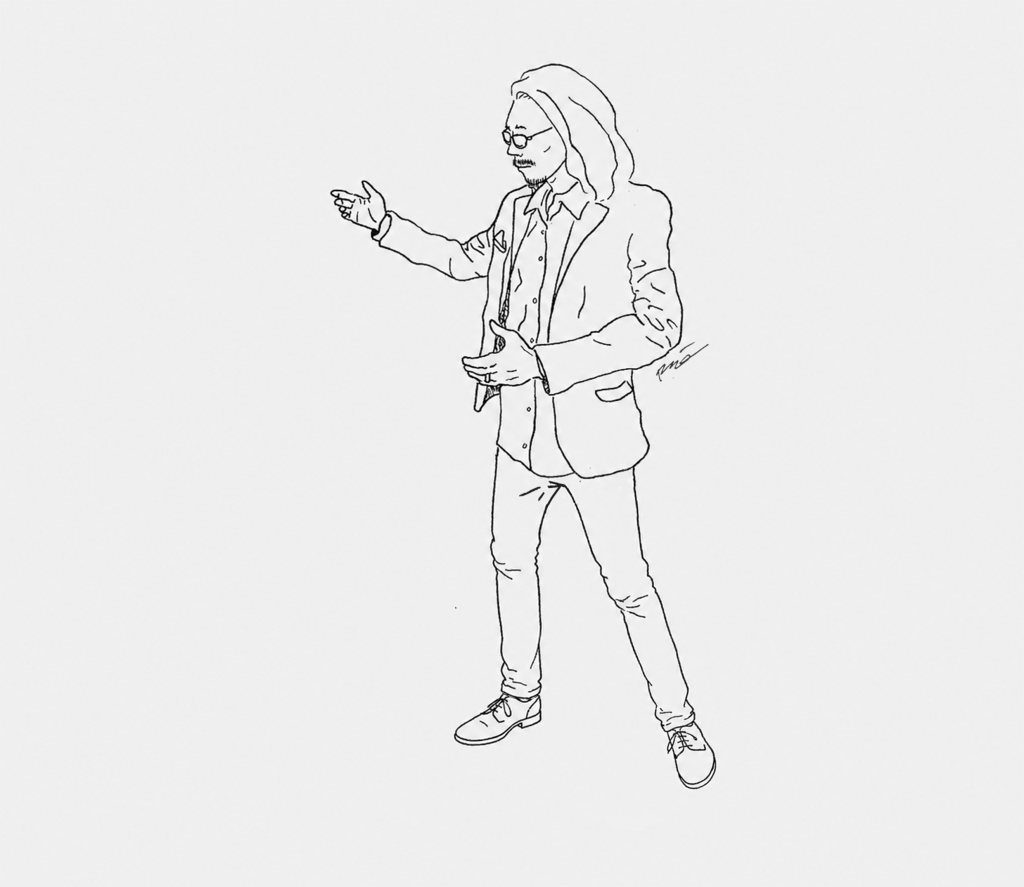
The digital spreadsheet tracking his job applications had long since stopped feeling like a tool for progress; it was a cemetery of his efforts. Over the last two years, he had sent fifty resumes to every available vacancy he could find. Half of the companies made him feel entirely invisible by never replying with a single word, leaving his applications to rot in digital voids. The other half chose different professional ways of saying “no,” their polite, automated rejection templates arriving like clockwork to dismantle his confidence piece by piece, as if the world were forcing him to slow down.
Instead of slowing down to breathe and ask himself what he truly wanted, however, panic drove him to stack more goals onto his already collapsing shoulders. He told himself he just needed to pivot, to try harder, to be more. He loved to draw, and he loved the artistry of ink on skin, so he thought, why not become a tattoo artist? He spent the last of his savings on the best affordable tattoo machine, ink, and practice fake skins he could find, convincing himself it was an investment he’d earn back in the future. But learning by himself in a cramped apartment without a mentor—because he couldn’t afford one—proved infinitely tougher than he thought, making every shaky, uneven line he drew on the rubber pads feel like another failure.
He didn’t stop there. He threw himself into the chaotic world of freelance graphic design, taking on underpaid gigs with demanding clients just to get any kind of income, completely stepping outside of his expertise. At the same time, he scrambled for low-paying freelance copywriting gigs, trying desperately not to lose his touch on a skill he had honed for 13 years. He was fiercely refusing to lose to the AI writing tools that everyone around him had suddenly started using, but the defiance felt exhausting. He fought on, entirely without realizing that he was just adding another layer of suffocating worry to his mind—that the looming fear of technology erasing his identity was blinding him to the toll it was taking on his soul.
The more the anxiety mounted, the more he smoked, his daily life becoming a monotonous loop of desperate reaching paced entirely by the steady burning of cigarettes. He smoked to calm the storm in his chest, often terrified that if he didn’t, he might actually forget to breathe when he got too focused on a task.
In the daylight, his small apartment remained a chaotic workshop of this anxiety: the hum of his laptop fan, the bitter smell of cheap tattoo ink, half-empty mugs of cold coffee, and the constant, agonizing routine of refreshing his email inbox every ten minutes. On his desk, an old ceramic ashtray overflowed, cigarette butts piling up and spilling onto his notes like small monuments to his restlessness as he ran a frantic race against a finish line that kept moving backward, creating problems out of thin air just to feel like he was moving.
But when the day finally began to slow down, and the harsh daylight gave way to the quiet dusk, a change came over him. As the sky darkened into deep indigo, he would give out a heavy, tired sigh, as if the clock had run out on another day of useless fighting. He would leave his cluttered desk, spark one more cigarette, and climb the dark stairs to the rooftop.
As he climbed, he shed the hectic life behind him to embrace the dark sky, fully knowing that up there, away from the digital noise, there was no one who expected a single thing from him. Leaning against the cold railing, he took a long drag, watching the pale gray smoke leave his lips. He tracked it with his eyes as it drifted upward, thinning out until it seamlessly became one with the night clouds above. A sharp pang of jealousy hit him. The smoke didn’t have to fight, or prove its worth, or apply for a place to belong; it just dissolved effortlessly into the atmosphere. He envied that ease, feeling a heavy frustration at his own inability to just be—to become one with the universe the way that smoke did.
Looking at the infinite expanse, he felt utterly insignificant. He was a mid-thirties copywriter without a desk, invisible to the city below and entirely useless to the grand machinery of the world. He felt like a speck of dust that had failed to find its place, completely disconnected from the dark, beautiful universe stretching out above him.
That crushing weight of insignificance didn’t leave him when he finally went downstairs; it followed him into his bed, pressing down on his chest through a sleepless night. When morning arrived, he woke up to the exact same loathsome loop, his life operating less like a human existence and more like a piece of heartless, mechanical machinery. He moved through his tasks without feeling, a clockwork sequence of boiling water, opening tabs, typing, and staring. He found himself trapped in a loop where he was constantly living in a future that didn’t exist, his mind endlessly rehearsing catastrophe, collecting anxiety more like a trophy he wasn’t proud of than a means of survival for the next Monday which hadn’t come yet. Day after day, the gears turned, the mechanical routine grinding him down until his spirit felt completely hollowed out.
On one of these nights, when the daylight had finally mechanicalized itself into dark, he returned to the rooftop simply to seek the only quiet space he had left. He didn’t climb the stairs with a dark plan in mind; he was just a tired man needing to breathe.
Leaning over the edge, he lit a cigarette, his heart hammering a frantic, erratic rhythm against his ribs from the sheer exhaustion of the week. Up here, a lone bat fluttered past, cutting through the night air with effortless grace, darting between the shadows without a single worry about its place in the world. It was so entirely free. He watched his cigarette smoke rise toward the clouds again, and that familiar, sharp envy flared up in his chest. Everything around him—the smoke, the wind, the wild things of the night—moved with an effortless belonging.
Suddenly, a spontaneous, terrifying thought drifted into his mind, as light and unbidden as the smoke itself: What if the only way to be that free, to finally stop the frantic race, was to simply step off? It wasn’t the choice of a quitter, but the sudden, desperate yearning of a runner who had spent two years sprinting on a broken ankle, suddenly realizing he could just let gravity take the weight to finish the race for him.
He needed a justification to satisfy his tired soul, a quiet assurance whispered to the dark: I tried my best, but it just didn’t work out. It was a final negotiation to absolve himself of guilt, so that if reincarnation existed, he could face the next life knowing he hadn’t surrendered out of cowardice, but because the machinery of this lifetime had simply run out of road. It felt like the only honorable exit from an excruciating existence.
He looked down at the street below, the vertigo blurring his vision as he leaned a fraction further over the railing, ready to surrender to that quiet freedom. Yet, even with his mind in a tangled mess, he found himself deeply enjoying his time up here. This rooftop was his sanctuary. Away from the screens and the rejections, he felt a profound, rare sense of peace settling into his bones.
It was almost perfect—a quiet, heavy stillness where nothing was expected of him. He stood there, tilted forward, looking up one last time to watch his cigarette smoke disappear into thin air. Then, he let his body sway slightly, closing his eyes to follow the gentle, effortless flow of the wind, feeling that the only thing left to make this peace complete was to simply let go.
And just as his center of gravity shifted, the universe intervened.
It did not arrive with a dramatic flash or a booming voice, but with a sudden, impossible subtraction. The ambient noise of the city—the distant rumble of a train, the hum of traffic, the sharp mechanical click of neon signs, and even the tiny crackle of amber from his own cigarette—abruptly dissolved into a profound, velvety quiet. It was as if someone had placed a giant hand over the mouth of the world, creating a stillness meant only for his soul to listen to an important, private message. In that sudden vacuum of sound, the frantic, mechanical rehearsal in his head stopped dead, as if swallowed whole into a black hole.
He didn’t fall forward, nor did he snap backward. Instead, he felt suspended at the very precipice of the ledge, as if the night air itself had grown dense enough to cradle the heavy burden he had been carrying for two long years. The wind that had been pushing him ceased to move. Everything froze, standing completely still just for him.
Then came the vibration. It didn’t start as a thought, but as a direct physical reaction—a low, deep resonance humming against the center of his chest before spreading throughout his entire being. It felt like a slow, melancholic piano tune that raised the goosebumps on his skin, flowing deep inside until it gently shook the very foundation of his soul. With every passing second, he could feel the pulse moving through his skin, easing into his muscles, and settling deep into his bones.
Without him noticing, this cosmic resonance had actually been there all along. It had been vibrating in the quiet growth of the trees down on the street, in the slow, unhurried rotation of the stars, and in the very breath he took while staring up at his bedroom ceiling. But he had been running too fast to hear it, too busy screaming his anxieties into the void, and too obsessed with chasing a phantom finish line to notice the rhythm that was already supporting him. The signal had always been transmitting; he had just finally stopped moving long enough to listen, right here in this very moment on the rooftop—alone, but not lonely. Finally.
As he actively let the frequency wash over him, his heart rate—which had been frantically hammering for months—slowed down, gradually resetting its rhythm to match this patient, cosmic pace. A profound warmth filled every vein in his body. He stood entirely frozen, sensing down to the very marrow of his bones a truth he had forgotten: he didn’t need to prove his worth to the city below, or to the job market, or to the passing years. He didn’t need to earn his right to exist. He was a physical extension of the night itself, a necessary piece of the vast machinery above. The stars weren’t rushing to shine; they simply existed in their perfect, brilliant timing. And he was part of that same design, as we all are in this universe.
In that state of perfect suspension, along with the mysterious vibration that ran through his entire being, a voice seemed to echo deep within—a gentle ripple he could not avoid. But at first, it was too low for him to hear. Like someone humming a familiar tune from the other side of a thick wall, he felt a sudden, profound familiarity, yet he was unable to put precise words to it so he could sing along with the universe. He stood there, frozen at the edge, listening to the quiet space inside his own mind. It was as if the universe had reached deep into his soul and was slowly pulling out a long-buried, comforting wisdom—a fond truth he had discarded years ago under the suffocating weight of adult worry.
He didn’t force it. For the first time in two years, he didn’t try to rush the answer. He simply let the internal melody untangle itself, note by note. He let each passing wave of this humming voice wash away everything else, until all that existed inside him was the hidden message. Slowly, in the vastness of the void, he merged with the universe, becoming a singularity. Then, as he was ready to let go of his existence, the universe revealed its cosmic mystery to him.
The familiar tune morphed into words he had read in a college library, a fragment of philosophy from Alan Watts that had been waiting for him to reclaim it all this time:
“The existence, the physical universe is basically playful. There is no necessity for it whatsoever… It is a musical phenomenon, and you are supposed to sing or to dance while the music is being played.”
The realization hit him not like a lightning bolt, but like a warm wave washing over a cold shore, bringing him back to that very moment of his solitude on top of the rooftop. He opened his eyes and looked down at his hands, then out at the distant horizon, seeing his life clearly for the first time. He had spent two agonizing years treating his existence like a race, viewing time as a cruel tyrant, and desperately sprinting toward a finish line that didn’t exist. He had been so terrified of being left behind that he had completely forgotten he was already standing on the stage, along with the waiting universe and its mystical orchestra.
A sudden, breathless scoff escaped his lips. It was a soft, quiet sound of pure, weightless release from his ignorance of the beautiful symphony playing before him. The universe hadn’t been punishing him with silence or rejection; it had simply been waiting for him to stop running, to stop treating his life like a problem that needed a mechanical solution. The job boards, the automated rejections, the financial panic, the desperate pivots into things he didn’t love—they were all artificial metrics. They weren’t the real world. The grand design required patience. It required him to trust the process, to drop out of the frantic race, and to simply be present in the melody of the moment.
Slowly, effortlessly, his weight shifted safely back from the precipice, his feet planting themselves firmly on the concrete of his sanctuary. He looked out at the infinite sea of stars, his chest rising and falling in perfect synchronization with the night wind. The lingering smoke from his cigarette drifted upward into the dark, no longer a source of jealousy, but a reflection of his own stillness. He smiled, a genuine, grounded expression, and whispered into the quiet expanse:
“Let’s dance, universe,” he said quietly to the universe from his soul.
It was not a literal dance, but a dance in the grand cosmic sense. He didn’t move a muscle, yet his soul stepped out onto the infinite stage of time and space. The artificial, heartless machinery of his daily struggle completely dissolved. Instead, the gentle rustle of the leaves below became his rhythm; the distant, muted hum of the city became his melody. In the quiet, brilliant theater of the present, his soul and the cosmos began their synchronized, patient waltz. He was no longer running toward an invisible future. He was finally, beautifully, exactly where he belonged, in the beautiful chaotic entanglement of the universe.

